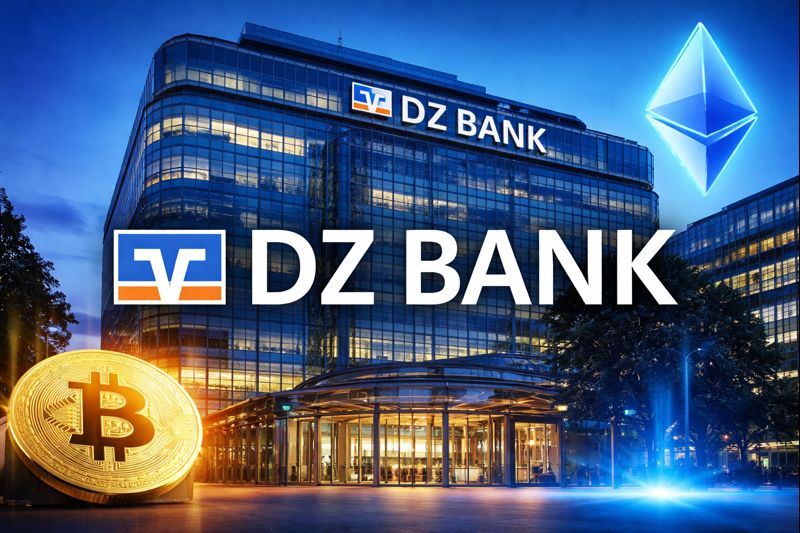
Germany’s second-largest bank, DZ Bank, has taken a decisive step into the digital asset market by approving Bitcoin and cryptocurrency trading.
The approval comes after DZ Bank received authorisation under the European Union’s Markets in Crypto-Assets Regulation, known as MiCAR.
The MiCAR regulatory clearance was granted by Germany’s financial watchdog, BaFin, at the end of December 2025.
With this approval, DZ Bank is now legally permitted to operate a crypto trading platform within the EU framework, and the bank has launched its crypto trading platform known as meinKrypto.
Bringing crypto trading into mainstream banking
The meinKrypto platform is designed to allow customers to buy, sell, and hold cryptocurrencies directly through their existing banking environment.
The platform is integrated into the widely used VR Banking App, which serves customers of Volksbanken and Raiffeisenbanken across Germany.
The technical and operational setup behind meinKrypto involves multiple regulated partners.
Boerse Stuttgart Digital Custody is responsible for safeguarding crypto assets and ensuring institutional-grade security standards.
Trade execution is handled by EUWAX, while IT integration is supported by Atruvia, the cooperative sector’s technology provider.
This collaborative structure allows smaller banks to offer crypto services without building their own infrastructure.
It also centralises compliance and risk management under established financial institutions.
By embedding crypto services into an established banking app, DZ Bank aims to remove technical barriers often associated with digital assets.
Customers will not need to manage private keys or rely on external crypto exchanges.
Instead, the trading experience is structured to resemble traditional online banking transactions.
At launch, meinKrypto supports major digital assets including Bitcoin (BTC), Litecoin (LTC), Ethereum (ETH), and Cardano (ADA).
These assets were selected due to their liquidity, market maturity, and regulatory acceptance.
DZ Bank has indicated that additional assets could be considered in the future, subject to compliance requirements.
The platform is intended for self-directed investors rather than advisory-based investment clients.
This approach aligns with regulatory expectations under MiCAR, which emphasises transparency and investor responsibility.
Phased rollout strategy
Although DZ Bank has received MiCAR authorisation, the rollout of meinKrypto will occur on a bank-by-bank basis.
Each local cooperative bank must independently notify BaFin and opt into the crypto service.
This structure allows individual institutions to decide whether crypto trading fits their customer strategy and risk profile.
Early indications suggest a strong interest within the cooperative banking network.
Industry surveys show that more than one-third of cooperative banks are prepared to adopt the platform.
This level of interest highlights growing demand for regulated crypto access among retail banking customers.
DZ Bank’s role is to provide the regulatory framework, infrastructure, and technical backbone for participating banks.
Local banks, meanwhile, maintain their direct customer relationships and onboarding responsibilities.
The post Germany’s second-largest bank, DZ Bank, approves Bitcoin and crypto trading appeared first on Invezz